> ## Documentation Index
> Fetch the complete documentation index at: https://docs.supaboard.ai/llms.txt
> Use this file to discover all available pages before exploring further.
# Create and save a query
> Choose a data source, run a query, and save a reusable result.
Query Bench is useful when you want to control the query behind an answer. If you prefer to ask in plain English, start with [the Analyst](/analyst/overview).
## Before you begin
You need Query Bench access, permission to create queries, and an active data source you can use. A shared query needs **Can edit** access before you can change its SQL or variables.
## 1. Open Query Bench
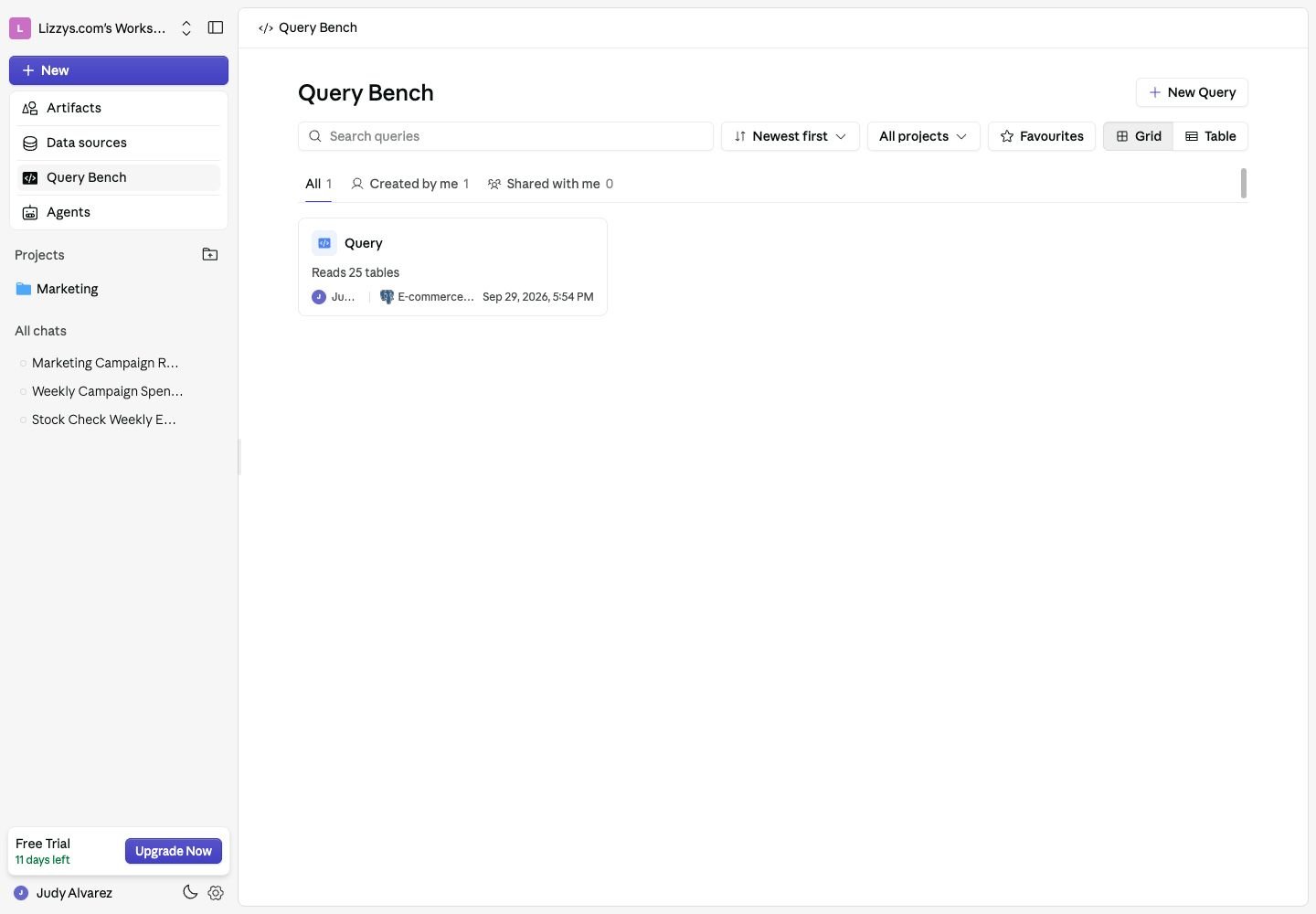
Choose **Query Bench** in the sidebar, then **New Query**.
 ## 2. Choose the source and language
Enter a descriptive query name and select the data source. For a SQL database, use **Native Query Language**. Python and queries across multiple sources require the corresponding workspace feature.
Create the query to open its editor.
## 3. Write or ask for the query
Use the **Schema** panel to find the tables and columns. Write your query, or describe the result to the **Assistant**. For example: “Monthly completed orders and net revenue for the last 12 months.”
Review an AI-proposed change before accepting it. Check the time period, status filters, joins, and metric definitions. See [Writing SQL queries](/query-bench/writing-sql-queries) for examples.
## 4. Run and inspect
Choose **Run Query**. This runs and saves the query. Inspect the returned table, then switch to a chart or KPI if that representation fits the result.
If it fails, read the error, check the referenced tables and columns, and ask the Assistant for a correction if needed. A successful execution still needs a check that the numbers answer your question.
## 5. Save and reuse
Use **Save** when you want to keep an edit without running it. Return from Query Bench to reopen the saved query later.
Use the result's **Pin** control to add an appropriate visualization to a dashboard. You need permission to add widgets to that dashboard.
## Expected result
Your named query appears in Query Bench and can be run again. Its saved definition is separate from a downloaded result or a screenshot.
## Next steps
Explore [Query Bench settings and history](/query-bench/overview), or [edit a dashboard](/dashboards/how-to/edit-a-dashboard) to arrange the pinned result.
This documentation is built and hosted on [Mintlify](https://mintlify.com), a developer documentation platform.
## 2. Choose the source and language
Enter a descriptive query name and select the data source. For a SQL database, use **Native Query Language**. Python and queries across multiple sources require the corresponding workspace feature.
Create the query to open its editor.
## 3. Write or ask for the query
Use the **Schema** panel to find the tables and columns. Write your query, or describe the result to the **Assistant**. For example: “Monthly completed orders and net revenue for the last 12 months.”
Review an AI-proposed change before accepting it. Check the time period, status filters, joins, and metric definitions. See [Writing SQL queries](/query-bench/writing-sql-queries) for examples.
## 4. Run and inspect
Choose **Run Query**. This runs and saves the query. Inspect the returned table, then switch to a chart or KPI if that representation fits the result.
If it fails, read the error, check the referenced tables and columns, and ask the Assistant for a correction if needed. A successful execution still needs a check that the numbers answer your question.
## 5. Save and reuse
Use **Save** when you want to keep an edit without running it. Return from Query Bench to reopen the saved query later.
Use the result's **Pin** control to add an appropriate visualization to a dashboard. You need permission to add widgets to that dashboard.
## Expected result
Your named query appears in Query Bench and can be run again. Its saved definition is separate from a downloaded result or a screenshot.
## Next steps
Explore [Query Bench settings and history](/query-bench/overview), or [edit a dashboard](/dashboards/how-to/edit-a-dashboard) to arrange the pinned result.
This documentation is built and hosted on [Mintlify](https://mintlify.com), a developer documentation platform.